Friday, November 21, 2014

Xi'an Terracotta Warriors

One of my dream trips has been to go to Xi'an to see the Terracotta Warriors. Drew and I had a nice break of time in between when he got back from Taipei and my friend Megan was arriving from Denver, so we took advantage and went out for a 4-day weekend. It is only a 3 hour direct flight from Hong Kong to Xi'an, so its very doable for a long weekend. I have always been poor with Chinese geography, and for some reason, I had it imprinted in my mind that Xi'an was on the western half of China. The name means Western Peace for goodness sake. However, if you look at a map of China, Xi'an isn't even located in the western half of the country! It's actually almost straight north from Hong Kong!


Anyways, Xi'an is an amazing place for several reasons. It is considered one of the ancient capitals of China, housing the ZhouQinHanSui, and Tang dynasties. It is also the starting point of the Silk Road, or ending point depending on your perspective! It was called Chang'an in ancient times, and it is estimated that back in 726 AD, more than 1 million people lived within the city walls. That's a ton of people for ancient times.  Now it currently has 6.5 million people. The city is known not only for its history but also for its food! The first afternoon in Xi'an, we walked from our shuttle drop off to the Hui Min Jie, or Muslim Street, the mecca for street food in Xi'an. We began the evening with our first try of Rou Jia Mo, which was essentially a homemade hamburger bun filled with pork or lamb minced with peppers. Delicious! We didn't know it at the time, but this rou jia mo was the best one we'd have all weekend! Flaky crust on the outside, juicy meat on the inside. 


We saw this cool sculpture on our walk into town from the airport shuttle drop off. Very cool, but no idea what it is about. Probably an ancient Chinese proverb. 


The next day we went right to the core of the trip, going to see the Terracotta Warriors. The Terracotta Warriors have been on my bucket list for a long time, so I was thrilled when we actually got to go see them. The museum is very picturesque. It's located about an hour outside of Xi'an, nestled amongst some foothills, and it was autumn, so the air was nice and chilly. The grounds were made like a garden, with all of the different pits (1, 2, and 3) in covered buildings. There was also a museum which we went into first. They had some of the fully reconstructed warriors there, so it was nice to see them really up close, as when they were in the pits you were always some distance away. The warriors were made for Emperor Qin Shi Huang, the first emperor of China. Qin Shi Huang unified the Waring States of China in 221 BCE, creating the first unified China. He also commissioned the connecting of smaller, lesser walls into the Great Wall! This guy did a lot in his life time! The Terracotta Warriors were replicas of his actual army and were supposed to protect him in the afterlife. Work began in 246 BCE, when Qin Shi Huang was 13 years old and required 700,000 workers using assembly like production methods. Work ended in 208 BCE, 38 years in total. Qin Shi Huang had already died in 210 BCE at the age of 50. 

The coolest thing about the terracotta warriors is how individualistic they are. Each warrior has a unique facial expression, and they all wear varying clothing and were holding various weapons depending on their rank in the army. Even the hairstyles were dictated by rank, but there were individual differences warrior to warrior. Amazing. The height of the warrior also depended on rank. 


Another cool thing, which I never realized, was that all of the warriors were originally painted in bright colors. The paint eventually leeched into the soil over time, but sometimes the pigment got stuck in the soil right next to the warrior, so they could pick out what pieces were colored what. Below is their idea of what the warriors looked like originally. The warrior crouching on the left would have been an archer holding a crossbow, while the standing warrior is likely a general or an advisor, considering he isn't even holding a weapon. 


We started off with the smaller pits 2 and 3, leaving the big daddy pit 1 for the rand mcnally. Below is a picture of Pit 3 where they have reconstructed a large portion of the statues within. 


However, this is a picture of work in progress. Apparently the warriors were housed in a building with a timber roof and thatched matting. Over time that wood rotted, and eventually the timbers fell on the statues themselves, breaking them into hundreds of pieces. However, as you can see below a lot of limbs would remain intact, but simply separated from the main torso. 


This was pit 1. It was as large as an aircraft carrier hangar. I'd say, between all 3 pits combined, they have reconstructed only 20% of all of the warriors. Considering they found these guys in 1974 by local farmers digging a well, it's taking them a long time to make any progress! The things were built in 38 years, and the Chinese have already taken about 40 years to uncover what they have. But, I guess putting a puzzle of hundreds of pieces together is harder than running a pottery assembly line. 


I loved just looking at the facial expressions of them. Some seemed very mad to be there, while others look fairly pleasant!


Most of the warriors were facing one direction, but on the borders of the army there were scouts facing the sides, protecting the army's flanks. Every detail was paid attention to.


 These guys are being reconstructed. What a puzzle that must be.


Outside of the grounds was a lovely statue of running horses. Not sure how they relate to the warriors, but it was a cool statue. Like the bird?


This is the actual mausoleum of Qin Shi Huang. Apparently it hasn't been excavated yet. Drew and I didn't realize that, so we walked around the entire thing looking for an entrance that didn't exist. Should have read the description of this place more closely!  I couldn't believe it hadn't been excavated yet, so I researched via Wikipedia to get some answers. They say that they don't want to wreck the artifacts inside, especially if there are more painted objects, and the paint tends to peel off as soon as it is exposed to air. So I guess no one gets to see anything instead of people getting to see something that might be damaged to a certain degree? Or maybe they are waiting for new technology to be invented to handle this paint peeling problem before diving in? I asked Lisa, my language partner, about why not, and she had an interesting answer. She said that a lot of emperors would booby trap their tombs to prevent thieves from ransacking it. I laughed at this. Haven't we watched Raiders of the Lost Ark and The Mummy enough times to know what to look out for? Decapitation, poisionous gas, and flesh-eating bugs. Surely we have a hazmat suit that can save us from that. Or, lets just send in a robot! If we can explore Mars without harming humans, surely an ancient tomb of the first emperor of China is doable. I just can't imagine all of the amazing stuff that is in there that noone gets to appreciate.


Nearby the mausoleum was another pit with a full chariot and more warriors. The two middle warriors are chariot drivers, while the outer ones with their hands in their sleeves are advisors.


This is a fake, but a good pic of Drew outside the gift shop!


The bus we took to the Terracotta Warriors left from the main Xi'an Train Station, seen below. 


Since it was going into winter time, apparently the only fruit in season is pomegranate and persimmion. Every fruit seller we saw had only those two items. Talk about a lack of selection! And how do you decide, seller #3 out of 15 has the best pomegranates, definitely..... 


Of course we went back to the Hui Min Jie for more street food. We actually went back there every single night! :) Potatoes in Sichuan spices anyone? The Sichuan province known for their spicy cuisine is very close to the Shaanxi Province where Xi'an is located.


This was a dessert with glutinous rice covered in jam with sesame and peanuts on the outside. Not my favorite dessert, but still tasty. 


The city has several famous landmarks since it is so ancient. One of those landmarks is the Drum Tower, located very near the center of town. 


The Drum Tower was beautiful at night all lit up. See the strand of lights going up into the sky? They were actually lanterns tied together on a string. Sometimes they were kites too. Very pretty. 


The other landmark, right near the Drum Tower and the Rui Min Jie is the Bell Tower, built in 1384. Apparently the drums in the Drum Tower were beat at the end of the day, and the bells in the Bell Tower were rung at daybreak.


We really enjoyed walking around Xi'an. With so many historical buildings to see, it was always interesting. I would say that the roads in Xi'an are very wide, unlike a lot of downtown roads in American cities, which tend to be narrow, squashed one-ways. These were large thoroughfares, and, as such, had HUGE pedestrian crossings to get across the intersections.


We passed by a fish market, and this little crab was making a dash for it! He almost got away, until a teenager walked passed and plopped him back into the bucket. I wonder how many times he had attempted escape?


Finally, this was a really cool building in the Rui Min Jie. Notice the shutters and the eaves! 


Monday, November 10, 2014

Taipei-National Palace Museum


After a long night out, the four of us went out for brunch at a Creole place. The food was so good, Drew ended up going there probably 5 times over the course of his two weeks in Taipei! I had the chicken and waffles, and they were unbelievable!


I was also fascinated by our hotel's parking garage. Inside the garage was a ferris wheel for cars, and I had never seen anything like it before! The cars would pull up onto the black circle, which would then rotate to line up exactly with the ferris wheel opening. Then, the car was driven onto the ferris wheel. Then the ferris wheel rotated, moving the car upwards and sideways while another open spot came down to take the next car. I'm guessing the whole ferris wheel would fit about 30 cars. Crazy! 


That evening, after our friends Andrew and Tiffany had jet-setted back to Hong Kong, Drew and I went back out to the night markets to try another round of street food. Tonight's menu included an oyster omelette, which was delicious! 


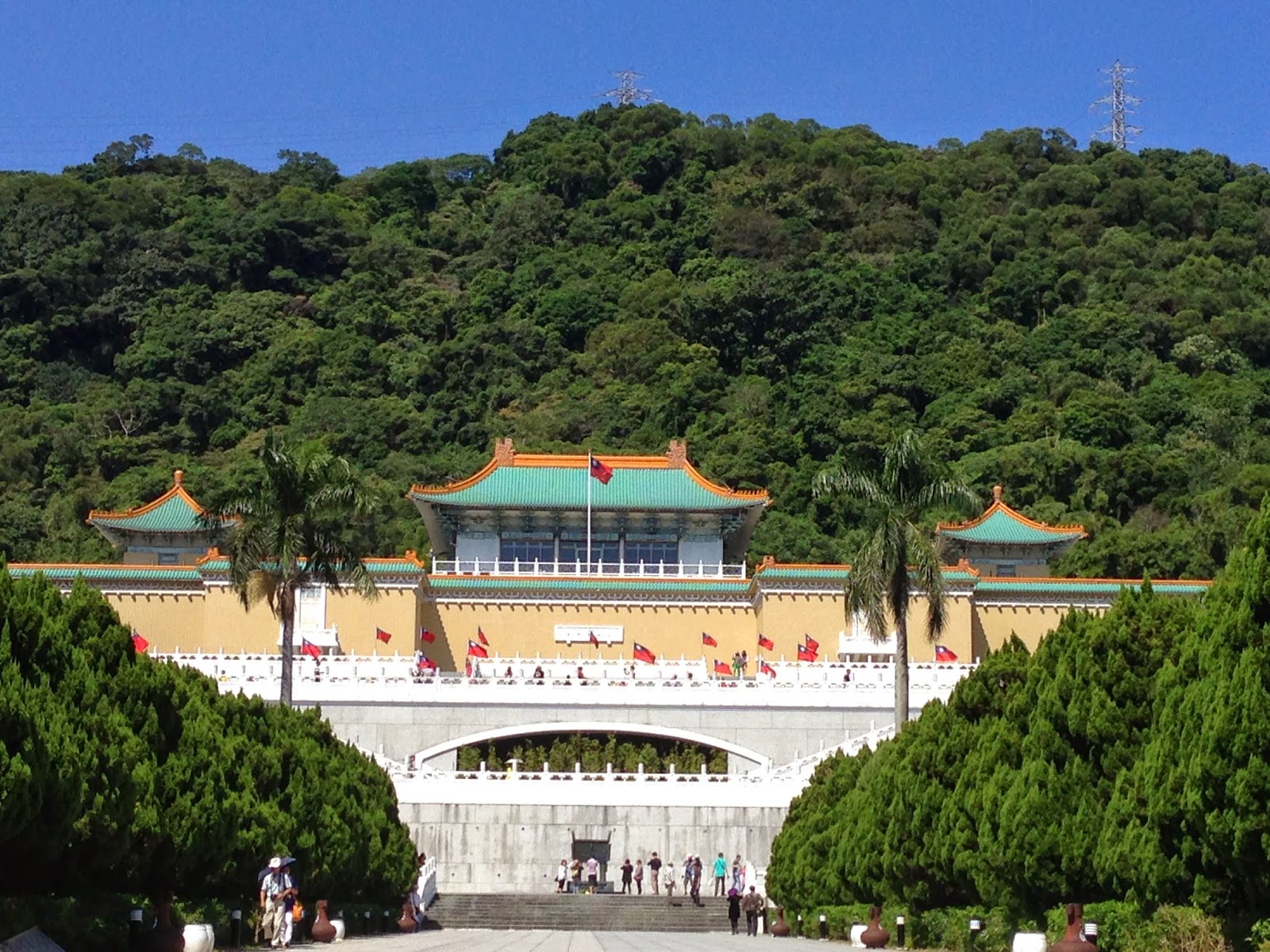
On Monday, Drew had to go back into the Taipei office, so I spent the day at the National Palace Museum. Apparently when the National Party fled to Taipei, they took a large assortment of the historical art and artifacts from the Forbidden City in Beijing with them to Taipei. This museum now has the largest collection of Chinese art and artifacts anywhere in the world, including within China itself. There is a standing joke in Taipei that if China ever wanted to bomb Taiwan, the one place they wouldn't touch is the museum due to all the priceless works of art. So, head there for a bomb shelter!


The museum was filled with pieces ranging throughout Chinese history. This is an ivory pillow.


Below is a black clay cup, made in the Neolithic Era, about 3,000 BC. That makes this cup more than 5,000 years old! Unbelievable isn't it! And I can only think back through my family about 6 generations, which is only about 150 years of history. What fascinates me most about this cup is how ornamental it is. The handle has slits in it, it's glazed, and it has an interesting shape! This is way more than just your functional cup for water. What fascinates me most about history itself is it shows us how little and how much we, as a species, have changed over time. Yes our cups now a days might be made out of more precise, advanced materials for durability and heat retention, and yes our cups might have cool logos and designs representing our advanced society with governments, schools, and companies, but I am still just a lady drinking a beverage out of her ceramic, glazed coffee mug, just like my ancestor did 5,000 years ago. Not much has changed; our most basic human needs are still very much the same. 


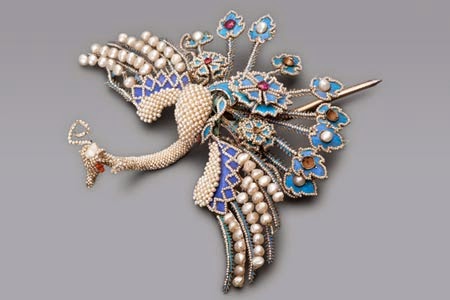
This is a jeweled hair pin in the shape of a peacock, used by ladies in the royal palace.


This carving was the most unique piece of art I have seen in a long time. I think I liked it so much because so much math was involved to make it work. The sculpture was carved from ivory. The top section is a sphere with about 12 smaller spheres inside of it. Each sphere was progressively smaller, allowing it to fit inside the last, like a Russian nesting doll toy. However, each sphere was also carved completely, with its own unique theme, so if you looked through one layer you could see the carving theme of the next sphere, and so on. And, if you theoretically lined up all of the spheres perfectly, there would be a hole that would go though each layer perfectly. I've never seen anything so ornate and complicated, but executed so beautifully.


Another hair pin, this one made with turquoise.


These are jade earings from the Neolithic Age, also known as the Stone Age, the same era as the black cup. I, again, was unaware humans in that age had any free time to do anything other than find food and protect themselves. But, these people had time to make jade earings!


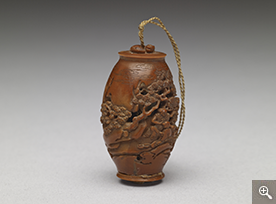
There were also several art pieces whose sole purpose was to show off the mastery of Chinese artists. This is a nature scene carved into an olive pit. Now, I do love a good olive, so I am well aware how large an olive pit can seem when you accidentally bite it. However, this piece made me realize how small an olive pit actually is, and how even more amazing it was for the artist to carve an entire nature scene into it. I actually couldn't see the detail of the piece with my naked eye; I needed a microscope to really see the detail. 


On the walk back to the hotel, I passed through a lovely park. You'll notice the weather was beautiful. We had great clear blue skies and the weather had a slight chill, really welcoming autumn. It was a really nice change from Hong Kong.


For dinner, Drew and I stumbled on a noodle shop that specialized in dao xiao mian, or knife cut noodles. Each noodle was cut, or almost peeled, from a large block, forming noodles with inconsistent shape and thickness. They tasted delicious and were really nice to eat texture wise. The hand cut noodles were then put into a traditional beef broth, which is a famous Taiwanese dish. 


Also on my walk I saw a few more beautiful buildings around downtown Taipei. This was the national hospital. Apparently Taiwan has one of the best health-care systems in the world. Any resident can go see any specialist for free! And they also have one of the lowest cost systems in the world. Let's go see how Taiwan is doing it!


Taiwan had a really cool energy and culture, and this is one example of the Taiwanese people speaking out politically against China. I'm sure this is just one opinion out of many, but it's nice to see them expressing their opinions freely. 


Finally, as I headed to the airport on Tuesday morning, what did I see but my beloved Denver Broncos playing football! It's amazing because football is not popular in Asia, and why the Broncos? The game against the 49ers was played on a Sunday, and this was a Tuesday, so it was definitely a replay of the game. Maybe because of Payton Manning's 509th touchdown pass? Not sure, but I was the only person in the airport lounge who cared.


Sunday, October 26, 2014

Taipei-Dream Parade and Raohe Night Market

Drew went to Taipei, the capital of Taiwan for two weeks for a work trip. The first part of his trip was for a conference, so he got to go to a few dinners and events, one of which was at Taipei 101, the tallest building in Taipei, and second tallest in the world, the tallest being the Burj Khalifa in Dubai. 


The building is supposed to look like sprouting bamboo, which represents flexibility, rapid growth, and strength, all good traits for a financial hub. 


Drew's view from the top! This building dwarfs every other building in the city. 


Drew also got to explore some more remote places, like this artistic village, where everyone was learning how to swing dance! 


I traveled to Taipei to spend the weekend with Drew. It was good timing, as neither of us had been to Taipei before, and free accommodation is hard to turn down! I got in really late Friday night, and our friend Andrew was also planning on coming to spend the weekend in Taipei, as it is only an hour and 20 min flight from Hong Kong. However, Andrew surprised us by bringing along our other good friend Tiffany. So it was a best bud reunion in Taipei, and we had a great time! 


The first order of the day was to find something to eat. So, we went to the nearby Main Train Station, as they had tons and tons of restaurants on the second floor of the station, recommended by our Taiwanese friend Tina. The station itself was old and in desperate need of renovation, but the food was amazing, a theme we'd see repetitively throughout the trip! 


Drew and I have always been a fan of bubble tea, and it was actually invented in Taiwan! They really like the soft, chewy texture of the tapioca pearls. Needless to say, we drank as much bubble tea on this trip as we could get our hands on!


Lunch consisted of 3-cup chicken, a chicken stock soup, pickles, edamame, and flavoured rice. Yum!


Tiffany had a delicious noodle dish and a chicken cutlet.


Dessert was a cream puff made at a cafe called Papa Beard. Never saw a cafe make only cream puffs, so I had to try it. They took the puff and filled it with cream right before your eyes! It was the best I'd ever had. 


While most Taiwanese people drink tea, coffee shops are starting to make headway. 


On our walk around the city, we found a lovely park with beautiful pagodas. 


The park also held the Taiwan National Museum. Didn't go into this one, but the building is pretty. 


This is the Presidential Office Building. The architecture in Taipei was interesting. Most of the city is actually quite ugly because when the Nationalist Party fled mainland China when Mao's Communist Party was taking over in 1949 after the Chinese Civil War, aka the start of the Cultural Revolution, lots of people fled to Taiwan. They needed new housing fast, so they built these really ugly concrete structures, which no importance placed on aesthetics. So, most the city is nothing special to look at. However, a few of the governmental buildings, such as the Presidential Office were obviously built with more care.


We somehow ran across a wonderful event called the Dream Parade, totally unexpectedly. The parade was the creation of an intentional artistic community where all of the residents are required to participate in the parade, making floats, costumes, and dance and drumming routines.  Also, if you own a property within the community and then want to sell it, you can only keep 3% of any profits made. The rest is given back to the community to support events etc. The community sounds really interesting, and the resulting parade was great as well. It was modeled after Mardi Gras, Rio's Carnival, and Burning Man. People were literally dressed in anything you could think of, and there were tons of kids doing drumming routines. This parade was quintessentially Taiwanese, which is known for freedom of expression and doesn't have the same censorship and propaganda as what you see in mainland China.


The parade ended at this large road section blocked off at either end. This large gate was at one end of the road, actually in the middle of a roundabout. It must have been a gate and a part of an ancient wall. 


After the Dream Parade, we walked on to another park, which held the Chiang Kai-shek Memorial. This was the gate leading to the Memorial. Gorgeous huh?


Also in the park was the National Concert Hall and the National Theatre. They were beautiful matching buildings with traditional Chinese construction.


This is the actual Chiang Kai-shek Memorial. It was closed, so normally the doors are open and there is a statue of the famous man inside. Taiwan has an interesting relationship with Chiang Kai-shek. Tina, if you're reading this, please comment on anything that is inaccurate or misleading, as you are the obvious expert here. Chiang Kai-shek was the leader of the National Party during the civil war with Mao's Communist Party, so once they lost the war (and many people blamed him for that loss) they fled to Taiwan, establishing a new government there. However, it seems like he got a bit paranoid, because for the next almost 40 years, he imposed martial law, imprisoning anyone who seemed to side with the Communist Party back in mainland China. This time was known as the "White Terror," and I'm sure a lot of people blame Chiang Kai-shek for that as well. So, it's a love-hate relationship I guess. Nowadays, Taiwan still has a very interesting relationship with mainland China. China considers Taiwan a part of China, and Chinese citizens considered Taiwanese people to be Chinese. However, Taiwan considers itself to be its own republic, and a Taiwanese person will always say they are from Taiwan, never from China. Mainland Chinese people need a special visa to enter Taiwan, so clearly the borders are not wide open. Not sure about the other direction, ie., Taiwanese visiting mainland China. 


After our park exploration, we went to a night market to stuff our faces with street food. This is a well-beloved past time of Taiwanese people. We went to the Raohe night market, and it was great! We tried so many different dishes; I think we counted 20 in total by the end of the evening. The weirdest one was a pig's blood cake, made from pig's blood and sticky rice and covered in peanut dust. Not a favorite of mine. 


There was also a gorgeous Chinese temple just outside of the night market. I've never seen one so ornately decorated! It almost looked Hindu-esque!


These are dumplings baked in a brick oven, right on the street! There was about a 30 person queue for these, so we knew they'd be good!


Pan fried dumplings!


The last dish of the night was a mango ice mountain, or shaved ice, ice cream, and pieces of mango Yum!