Monday, July 28, 2025

Nevado de Chillan

 The boys are currently on winter break from school; they get two weeks off in between the first and second semesters. We wanted to make the most of this time off, so we spent the first week skiing in Nevado de Chillan, which is a ski resort about 6.5 hours south and a bit west of us. It's a 6 hour trip if you're in a car, but the van, now known as Don Diego, goes a bit slower than that. We renamed the van Don Diego after reading and LOVING this kids book which is about a Siamese cat who wants to be a Chihuahua. He has imaginary Chihuahua friends, one of which is Don Diego, "the biggest of the small ones." Another imaginary Chihuahua is Poquito Tito "the smallest of the small ones," so we've named Grandma and Grandpa's van that, since their van is much smaller than ours. Did I mention we now own two vans?? We're starting a collection, it seems. The second, smaller van is for Grandma and Grandpa to travel with us on our summer break camper van extravaganza down to Patagonia this coming Jan and Feb. So if anyone wants to visit us and borrow a van for your own explorations, we have a large and small model to chose from!

The night before we left, the parents of Emerson's class had a party to celebrate the end of the semester. The party started at 7pm, but most people didn't show up til 8pm.  Drew and I were the first ones to leave at 12am. The party invitation had an end time of 1am, but who knows how long everyone stayed. I don't think I'll ever get used to these late nights here. A parent party in the US would start at 6pm, and most people would be moderately on time, and it would be over and done by 10pm. Asleep by 10:30pm. 

We left Santiago on Saturday, July 12th at 9:30am; not a bad start considering our late night. There are ski resorts closer to us here in Santiago, but since we had the time to make a longer trip, we decided to go a bit further afield. We also were pseudo-traveling with another family who wanted to visit Chillan, so away we went. We basically drove 5 hours straight south on the main North-South highway called Highway 5.

That part of the drive was very lovely. It's mostly flat farmland with the Andes on the left. I loved seeing the farms with all sorts of different things: fruit trees, vineyards, and berry bushes were the most common. We then drove an hour and a half east towards the mountains. 

I like seeing the 5 hours we drove south in the grand scheme of all of Chile, and we didn't make it very far. This country is so long. 


We got to ski 3 days, Sunday, Monday, and Wednesday. The first day, Avery was a bit rusty, which is understandable as we hadn't skied in 18 months. We missed last winter's ski season in North America due to the move. His survival instincts kicked in, and on his first run he was inching his way down the bunny hill. But after 2 laps with Drew, he got his groove back. By the end of the first day, the boys were back to where they left off. On the second day, we got an all-day private lesson for the boys for $140, not too shabby. The goal was to get them started on parallel turns. Emerson made great strides. Avery has a bit more to go, but he isn't far behind. The resort was about the size of Monarch. Had enough beginner terrain to keep the boys occupied and a couple of blues. But at the top were all sorts of bowls above tree line that were great for advanced skiers. Some of the bowls weren't skiable yet due to not enough snow, as this was still kinda early in the season. They get most of their snow in August. But the views from the top were gorgeous. I got to ski the longest blue run in both North and South America, called Las Tres Marias which was 8 miles long. There were sections where I was completely alone for 10 minutes at a time; it was really nice. 


Skiing while camping in a van is a bit interesting. I was worried we would have soaking wet ski clothes that wouldn't dry fast enough. But between the diesel heater and an indoor clothes line, we were able to make it work. It actually never got super cold, so we didn't even need to run the diesel heater at night, only in the mornings when we were getting up. I might have had a mountain of blankets on me, but who's counting. Boys slept ok, so we slept ok-minus. The van doesn't have a black water tank, so instead the pee goes into a jug you can pull out and empty. The poops go into a container with a bag (at least you're sitting down on a normalish toilet seat), that you then seal up and throw away. Which is fine in the daylight, but it's less fun at midnight when your kid has to go. For the most part we parked the van overnight in the driveway of the little cabaña our friends were renting. Which meant we got to take showers halfway through and have dinners at a normal sized table. So, while this was the longest stint we've had in the van so far, it was still camping-light, I'd say, due to the extra amenities we had access to. This summer will be a different story.


Our friends have two little dogs that the boys are in love with. We're definitely going to have to get a dog when this adventure is over.


On the drive back home to Santiago, we stopped at a restaurant for lunch. There are many roadside restaurants along Highway 5, and some are actually quite good. The best dish we had was cazuela, which is a soup with a hunk of roasted meat, corn, potatoes, pumpkin, and cilantro. It's very flavorful and hearty, the perfect winter dish, and something all visitors to Chile should try. 

Tuesday, July 8, 2025

Buinzoo

Two weeks ago, we visited the Buinzoo which is about 45 min southwest of the city, where they have more room to spread out. For only $48 for all four of us, we had a full day of fun. We went with the Argentinian family we are becoming close to. They have two girls who attend the same school as ours, and they live in our building, so we see them all the time. The oldest one, Carola, is the same age as Emerson and therefore is in the same grade, but a different class. The younger sister, Olivia, is 4 and is in pre-kinder, so the class below Avery. All four of them get along great. Before moving to Santiago, we were wondering how easy it would be to make friends, and it has actually been much easier than I imagined, definitely easier than Hong Kong. Obviously the language is more accessible for us, but finding families with kids through school gives us an immediate network to tap into. In the picture below, Carola and Olivia are the two girls in the middle of our boys. They are super sweet. 


This zoo was nice because you could get relatively close to the animals, not like at the old section of the Denver Zoo where the animals feel a mile away. The first section had monkeys that would walk overhead crossing from one section to another. 


We got to see the fabled capybara, which is actually an hilarious creature. First, it is THICK. An adult male on average is 4 ft long and 100 lbs, so think like a chunky labrador. They live in groups of 10-20 and are found all over South America, but to the east of the Andes, so not in Chile. And they are technically the largest rodent on the planet. People here LOVE them and think they are the cutest thing ever. Girls will have capybara themed birthday parties. I think they have a funny resting bitch face, with which I can commiserate. 


The zoo also had an animal I had never seen or heard of before, something called the Patagonian Mara. It looked like half capybara half rabbit. "Behind the rabbit?? It IS the rabbit!!" It is also a rodent and lives in the Argentinian side of Patagonia, so again, east of the Andes. These guys were my personal favorite. I was fascinated that there exists a mammal that I had never seen before. Granted, I haven't traveled the whole world, but I've been to my fair share of zoos and museums, and have watched enough Planet Earth-esque documentaries to feel like I know most of the world's animals, well, mammals anyways. I'm sure there's plenty of insects and fish out there I've never heard of. But a mammal? Especially one as cute as this?!? Come on!! Again, North American ignorance for the win. 


Drew's favorite was the snow leopard. In the wild, these guys are very elusive, so it was cool to see one here. It was actually stalking a bird right before Drew took this photo. 


They also had red pandas there, which are another personal favorite. 


Most of the animals seemed to be in lovely enclosures that were clean and well kept. The enclosure for the rinoceronte for whatever reason was a muddy mess. Below Emerson is doing his best rinoceronte impression. 

There were baboons with their fiery red butts, so Emerson had to imitate them as well. 


I just included this photo because I love Avery's face. 


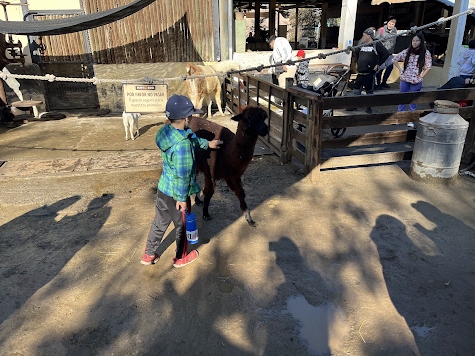
There was a petting zoo area where the kids could pet llamas, sheep, and some rabbits. Another family was in there at the same time, and, shortly after this, another little boy tried to pet the brown llama but for whatever reason the llama was not having it. He reared back his head and full on spit right in the poor little boy's face. I couldn't help but laugh. 


Avery's favorite animal was the donkey, of course. Except this was a special African burro, so it had striped legs. Overall, a great day!


Wednesday, June 18, 2025

Rapa Nui: Last Few Days

This last blog about Rapa Nui is going to be a hode podge of stuff we did in the last couple of days.  One of the last sites we visited was Vaihu, where they had recreations of the long houses the Rapa Nui lived in. The stone "foundation" of these long houses was really interesting because there were perfectly round, drilled holes for each support pole to go into. How did they make those?


Drew and the boys spent an afternoon playing around in the Playa Poko Poko, which is a little swimming hole close to town protected from the waves by a large stone wall. It wasn't a super sunny day, so I didn't go in, but the boys didn't seem to mind. 


Because Rapa Nui is an island, food is expensive, compared to Santiago at least. We knew this would be the case, so we packed an entire suitcase full of food and did most of our cooking at home. But, we went out a couple of times, mostly for ceviche, which was always awesome. Can't beat caught that morning seafood! One of the rainier nights we were craving a warmer dish, so we got a fish and chips platter meant for 4 people, and it was beyond humongous. It didn't stand a chance though. Not sure what kind of fish it was exactly, but the meat was red in color, so maybe a red snapper?


Our last night on the island, we went to watch the sunset at Ahu Tahai. This is one of the only ahus on the island you can approach without a guide, and it's the best one for sunsets. We weren't the only people with this idea; it was the most people we'd seen in one spot the entire trip, but the view was worth it. 


The boys discovered a "donkey" and wanted their picture taken with it.  


Monday, June 16, 2025

Rapa Nui: Tour Day 2: Rano Raraku, Ahu Tongariki

Day 2 of our Tour was by far my favorite. We started at Rano Raraku, which is the quarry from which all of the moai were carved.  There are so many of them just strewn about, seemingly abandoned. Many of them are "walking" down the hillside. Why were they abandoned? It's clear some broke in the moving process, but others look perfectly intact.


All of the moai are buried to some degree. assumingly by dirt eroded from the cliffs above. This particular moai that the boys are sitting in front of was excavated in 2010, and it's amazing to see photos from that. Under these floating heads are entire torsos, arms, and hands, exactly like the other raised moai around the island. And the carvings you can see are amazing. So intricate. This moai was reburied to protect it from further erosion. 


Here you can see a moai still in it's carving cave, almost like Snow White waiting to be woken up. All of the flat rock faces above it are places were other moai were carved out. There are more than a 1000 moai around the island. That's an unbelievable amount of rock shifted to accomplish such a feat.


This next picture is not the nicest to look at, but I took it to try and show how dang steep the cliffs were above the moai we were looking at. How in God's name did they manage to get the moai down in a controlled manner after they were done being carved? These things are on average 30 feet tall and weighed 10-12 tons. An unloaded semi-truck tractor (not including the trailer) weighs 12.5 tons in comparison. Gravity would be both friend and foe here; easy to get things moving, but easier to lose control and have a moai avalanche. But most of the moai we were looking at on the hillside were intact, not smashed to bits, so they had a method to get them down safely somehow. 


In the picture below, directly behind our guide's head is the torso of the largest moai found on the island. Follow that torso up and you can see the moai's chin and nose. It is called Te Tokanga (El Gigante) and is almost 72 feet long and weighs around 150 tons. These guys had big plans!


Here is an aerial shot of him. 


More moai left in their carving niches. Why were they left half finished? Our guide believes something cataclysmic happened that caused the alien race working on these guys to suddenly leave and abandon everything. Sadly, the real reason is probably something more tragic (more tragic than a cataclysmic event? jaja) like famine, war, or disease. It's hard to work on art when your basic needs aren't being met. This is one of the reasons why people believe the Rapa Nui suffered a societal collapse, even before the Europeans showed up, but no one can say for sure. So many questions.


From Rano Raraku, down the hillside you can see Ahu Tongariki which we would visit next. 


A fallen moai with his brothers at Ahu Tongariki standing in the background. This is me attempting to be artistic with photography. But just like all my jokes, I feel the need to explain myself, which ruins it, jajaja.


This moai is the only one found to date in a kneeling posture. You can see his legs and feet tucked under his little booty. The story from our guide was that this man was walking with his son along the cliffs above, and the son fell and died. So they carved this moai to commemorate his grief and sorrow. Does beg the question though of why did the Rapa Nui chose to carve all of the other moai in exactly the same posture? Yeah there are differences in height, size, and facial features, but they are all standing erect with their arms at their sides, hands on their bellies framing a loin cloth. Why not spice it up a bit? They carved a thousand of these things, but this guy is the only one that has legs, let alone is in a kneeling posture. I guess gods aren't suppose to kneel. 


Since Drew and I were being surrounded by so many conspiracy theories, we decided to come up with our own. This is a view of the other side of Rano Raraku. All of the moai we saw still in their carving niches and on their way down the hillside were on the southwest side of this volcano crater. But the southeast side of the crater is gone and is nothing but shear cliffs, while the other side is sloping and rounded, like all of the other internal volcano craters are (by internal I mean not along the coast to be affected by the sea). Our theory is that these cliffs are the direct result of the Rapa Nui carving the 1000 moai. They needed to shift an ungodly amount of rock to carve that many of those things, what else would have caused this? The second picture is from google maps with the terrain showing, and I think it looks pretty convincing, like a bite taken out of a donut. Well, I have no formal education in geology nor anthropology, and I researched this and thought about it for all of 5 minutes, so therefore I must be right. It's not an opinion, it's a fact! 😉


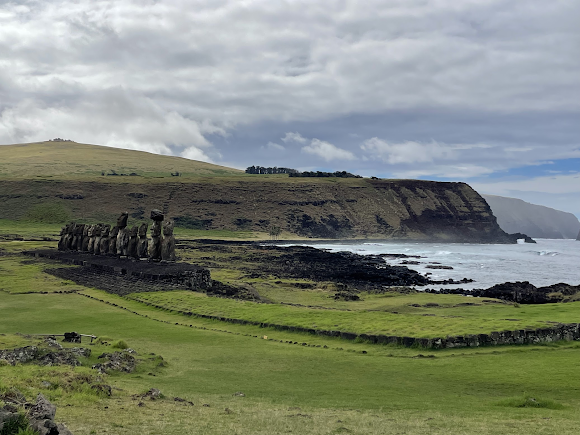
The second stop of the day was Tongariki, which is the grandest ahu, I think, on the island. It has 15 moai of varying heights and facial features arranged with their backs to the sea and facing the quarry we just left. Apparently all of these moai had been toppled but then also dragged much farther inland when a tsunami hit, date unknown, but they had to be moved quite far to be rebuilt. It's also impressive to think about how far the moai were moved originally to get from the quarry to their final resting place. At least here it seems plausible, because the quarry is within eye site of the ahu. But there are many other ahus on literally the complete opposite side of the island, which is miles away. Like 10 miles away or more! How did they move these colossal statues 10 miles or more with no help? One theory is that they rolled the moai on logs, hence the deforestation. Another theory is that they "walked" the moai upright by tying ropes to top of the moai and having three teams of pullers, forming a triangle. The two teams in the front would get it to rock from side to side while the 3rd team off the back would keep it from toppling forward, which is it's natural inclination, with the big belly and all. The only reason I am aware of this theory is that Drew and I watched a documentary about this before our visit. Seems highly error prone to me. No wonder there are so many moai scattered around the island that have crashed and burned. Here a link to a clip which shows a team of scientists testing the "walking" theory. It is almost eery to watch: https://youtu.be/YpNuh-J5IgE?si=mMiavipzPe-poiIJ      So it is possible to "walk" them, but could you imagine doing that for MILES???? Wowzer. 


There was one moai off to the side, closer to the entrance of Tongariki and not on the ahu, that we could get really close to. This particular moai was borrowed by the Japanese for a decade of show and tell back in Japan in exchange for a crane that was used to raise most of the moai and is still used at the marina today. It's hard to tell in the picture because it is so dark, but this moai had pupils, so it made his eyes look VERY expressive. Almost sad. Definitely moving.