Monday, June 16, 2025

Rapa Nui: Tour Day 2: Rano Raraku, Ahu Tongariki

Day 2 of our Tour was by far my favorite. We started at Rano Raraku, which is the quarry from which all of the moai were carved.  There are so many of them just strewn about, seemingly abandoned. Many of them are "walking" down the hillside. Why were they abandoned? It's clear some broke in the moving process, but others look perfectly intact.


All of the moai are buried to some degree. assumingly by dirt eroded from the cliffs above. This particular moai that the boys are sitting in front of was excavated in 2010, and it's amazing to see photos from that. Under these floating heads are entire torsos, arms, and hands, exactly like the other raised moai around the island. And the carvings you can see are amazing. So intricate. This moai was reburied to protect it from further erosion. 


Here you can see a moai still in it's carving cave, almost like Snow White waiting to be woken up. All of the flat rock faces above it are places were other moai were carved out. There are more than a 1000 moai around the island. That's an unbelievable amount of rock shifted to accomplish such a feat.


This next picture is not the nicest to look at, but I took it to try and show how dang steep the cliffs were above the moai we were looking at. How in God's name did they manage to get the moai down in a controlled manner after they were done being carved? These things are on average 30 feet tall and weighed 10-12 tons. An unloaded semi-truck tractor (not including the trailer) weighs 12.5 tons in comparison. Gravity would be both friend and foe here; easy to get things moving, but easier to lose control and have a moai avalanche. But most of the moai we were looking at on the hillside were intact, not smashed to bits, so they had a method to get them down safely somehow. 


In the picture below, directly behind our guide's head is the torso of the largest moai found on the island. Follow that torso up and you can see the moai's chin and nose. It is called Te Tokanga (El Gigante) and is almost 72 feet long and weighs around 150 tons. These guys had big plans!


Here is an aerial shot of him. 


More moai left in their carving niches. Why were they left half finished? Our guide believes something cataclysmic happened that caused the alien race working on these guys to suddenly leave and abandon everything. Sadly, the real reason is probably something more tragic (more tragic than a cataclysmic event? jaja) like famine, war, or disease. It's hard to work on art when your basic needs aren't being met. This is one of the reasons why people believe the Rapa Nui suffered a societal collapse, even before the Europeans showed up, but no one can say for sure. So many questions.


From Rano Raraku, down the hillside you can see Ahu Tongariki which we would visit next. 


A fallen moai with his brothers at Ahu Tongariki standing in the background. This is me attempting to be artistic with photography. But just like all my jokes, I feel the need to explain myself, which ruins it, jajaja.


This moai is the only one found to date in a kneeling posture. You can see his legs and feet tucked under his little booty. The story from our guide was that this man was walking with his son along the cliffs above, and the son fell and died. So they carved this moai to commemorate his grief and sorrow. Does beg the question though of why did the Rapa Nui chose to carve all of the other moai in exactly the same posture? Yeah there are differences in height, size, and facial features, but they are all standing erect with their arms at their sides, hands on their bellies framing a loin cloth. Why not spice it up a bit? They carved a thousand of these things, but this guy is the only one that has legs, let alone is in a kneeling posture. I guess gods aren't suppose to kneel. 


Since Drew and I were being surrounded by so many conspiracy theories, we decided to come up with our own. This is a view of the other side of Rano Raraku. All of the moai we saw still in their carving niches and on their way down the hillside were on the southwest side of this volcano crater. But the southeast side of the crater is gone and is nothing but shear cliffs, while the other side is sloping and rounded, like all of the other internal volcano craters are (by internal I mean not along the coast to be affected by the sea). Our theory is that these cliffs are the direct result of the Rapa Nui carving the 1000 moai. They needed to shift an ungodly amount of rock to carve that many of those things, what else would have caused this? The second picture is from google maps with the terrain showing, and I think it looks pretty convincing, like a bite taken out of a donut. Well, I have no formal education in geology nor anthropology, and I researched this and thought about it for all of 5 minutes, so therefore I must be right. It's not an opinion, it's a fact! 😉


The second stop of the day was Tongariki, which is the grandest ahu, I think, on the island. It has 15 moai of varying heights and facial features arranged with their backs to the sea and facing the quarry we just left. Apparently all of these moai had been toppled but then also dragged much farther inland when a tsunami hit, date unknown, but they had to be moved quite far to be rebuilt. It's also impressive to think about how far the moai were moved originally to get from the quarry to their final resting place. At least here it seems plausible, because the quarry is within eye site of the ahu. But there are many other ahus on literally the complete opposite side of the island, which is miles away. Like 10 miles away or more! How did they move these colossal statues 10 miles or more with no help? One theory is that they rolled the moai on logs, hence the deforestation. Another theory is that they "walked" the moai upright by tying ropes to top of the moai and having three teams of pullers, forming a triangle. The two teams in the front would get it to rock from side to side while the 3rd team off the back would keep it from toppling forward, which is it's natural inclination, with the big belly and all. The only reason I am aware of this theory is that Drew and I watched a documentary about this before our visit. Seems highly error prone to me. No wonder there are so many moai scattered around the island that have crashed and burned. Here a link to a clip which shows a team of scientists testing the "walking" theory. It is almost eery to watch: https://youtu.be/YpNuh-J5IgE?si=mMiavipzPe-poiIJ      So it is possible to "walk" them, but could you imagine doing that for MILES???? Wowzer. 


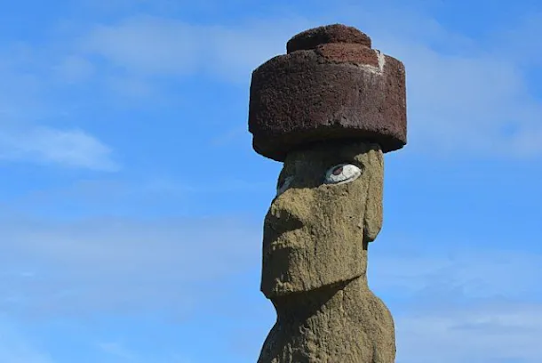
There was one moai off to the side, closer to the entrance of Tongariki and not on the ahu, that we could get really close to. This particular moai was borrowed by the Japanese for a decade of show and tell back in Japan in exchange for a crane that was used to raise most of the moai and is still used at the marina today. It's hard to tell in the picture because it is so dark, but this moai had pupils, so it made his eyes look VERY expressive. Almost sad. Definitely moving. 

Wednesday, June 11, 2025

Rapa Nui: The Farm

 One of our favorite parts of the trip was where we stayed. We rented a cabaña through Airbnb, which was located on a little farm. The house was the perfect size for us: 2beds/1bath (with a bunkbed!!). But the grounds were the best part. They had so many tropical fruit trees: guava trees, avocado trees, passion fruit vines, lemon trees, banana trees, and they also grow pineapple, but it wasn't in season. Everything else was though, and it was the best fruit I have ever tasted. Every day, the boys would go out and collect a few of each that had fallen to the ground, and we never ate better. 


Look at that stash!


Lemon tree!


Avocado Tree!


Banana Tree!


Passion Fruit Vines!

Apparently there are many types of avocados. Our Airbnb host had two different types growing on the farm, but in town we saw another variety shown next to boys' heads below for perspective. They were humongous!!


One night, right before bedtime, we got a knock at the door. Our Airbnb host had found a baby chick that had lost its mother, and it needed to sleep skin to skin with someone in order to survive the night. She asked if we wanted the job, and we said yes! The chick was the softest ball of fluff you ever felt and seemed lighter than the sum of its feathers somehow. Avery held him against his chest for one minute before he burst into giggles because it was too tickly. Emerson made it longer, basically 15 minutes until he was ready to fall asleep. Then I came in and got the little guy. I honestly don't know if Emerson could have slept with it all night without squishing it, but I wasn't willing to risk the little guy's life to find out. I slept with it tucked inside my sports bra for probably two hours, but then I inconveniently had a night sweat that was starting to drench the little guy and was counterproductive for the warmth he needed. So then Drew slept with him for the rest of the night. Drew has a slight indentation at his sternum, so the chick cuddled there amongst Drew's pillowy chest hair, and it seemed quite content. Only when Drew would turn over (slowly) would the chick let out a couple of cheeps, like "hey, I'm still here, don't forget about me!" Other than that, it was totally quiet, and it also didn't poop at all! So, Drew slept some, but not alot, probably the equivalent of sleeping with a newborn, an experience we have all but wiped from our memory.  Luckily in the morning, we found the mother hen, and the little guy was reunited with his family. 


On a separate note, Rapa Nui had some of the best empanadas we've had so far. They were huge, close to a calzone in size, and baked fresh daily. Our favorites were camarone (shrimp) y queso, machada (shredded beef), and "Neopolitano" (queso, basil, jamon). 


I was also in love with all of the flowers on the island. I had never seen so many various colors of hibiscus flowers. All of these I found either on the farm or within a 5 min walk of their property. 


The boys' favorite part of trip was undoubtedly playing with their neighbors, the grandsons of our Airbnb host. These two boys, Josecito and León, are technically Chilean, not Rapa Nui, and they spoke only Spanish. The boys would run from one end of the farm to the other for as long as we'd let them, with their only rules being to give the horse and bull a wide berth. They loved the freedom and the space and definitely didn't want to leave.


One rainy day, we went to an open house at the nearby Planetarium, and Drew befriended the Director, a young guy with two kids close in age to the boys, who also played chess. Another rainy day we met up with them for a playdate of lego building back at the Planetarium, and afterwards we went out for churros. What I assumed would be one basket of churros turned out to be an ice cream sunday with churros inside. Yes, it was as magical as it sounds. 

Monday, June 9, 2025

Rapa Nui: Tour Day 1: Orongo, Rano Kau, Anakena Beach, Body Painting Ceremony

We ended our first tour day at Orongo, which is a point at the southwest tip of the island where the Rapa Nui would host the "Bird Man" competition.  In this competition, each tribe/family/clan would delegate a participant.  The competitors had to swim from the island using a boogieboard-ish thing to this island where black terns come to nest each spring. The competitors would stay on the island for days or even weeks until the Terns started laying eggs. The competitors would steal an egg, put it in a little pocket that was woven into a special headband, swim back, then in their probably very weakened state, climb a huge cliff to the top. Whichever got back first with the egg intact won, with the prize being the biggest house, extra food, bragging rights, etc. The pic below shows the island, Motu Nui, they have to swim to.


While the participants are waiting/surviving on the rock, the families of the participants would move into these tiny, little stone bungalows overlooking the ocean and the bird island. Tourists aren't allowed to go inside the houses, but I can imagine they are dark and damp.  But, at least they are protected from the elements on the cliffside.


Also from this same area, a moai had been uncovered that is currently living in the British Museum. This moai has carvings or petroglyphs that show scenes from the Birdman competition. The Birdman competition came about a bit later after the moai were carved, so this moai was likely relocated to the ceremonial village of Orongo and the carvings added later. I find it amazing how much better condition are the moai that were buried left underground. It's amazing what weather can do to exposed rock over time.


This is the spot where the moai was discovered. Drew and I have a goal to visit our friends Andrew and Corey in London to see this moai at the British Museum to complete the circle.


On the other side of the point that Orongo perches on is a huge volcano crater, called Rano Kau. The natural beauty of the island is stunning. 


The day after the tour, we had our best weather day, so we went to Anakena Beach. It was GORGEOUS: super soft sand, gentle waves, warm water, palm trees, and an ahu with moai in the background. We stayed there all day and went back one other day because we loved it so much. I would fly to Rapa Nui again simply to go to this beach. Now granted, we were visiting during the off season, but this is literally the only white sand beach on the island, and it was a Saturday with perfect weather, and it wasn't crowded whatsoever. There are also restaurants and bathrooms by the parking lot, so you can have as much or as little convenience as needed.


We ended our beach day by going to a Cultural Show that was being put on for El Dia de Patrimonio, which is a Chilean cultural weekend. What it meant on Rapa Nui was a body painting and poetry recitation competition. The competition began with a blessing by a Rapa Nui elder, then a buffet of Rapa Nui traditional foods that was super yummy, then a few songs and dances by a Rapa Nui group. For the body painting competition, they used traditional techniques that mimicked the carvings on the moai, then recited a poem in Rapa Nui. The boys were falling asleep by the halfway point, so we left then, but overall it was super cool, and I'm so glad we went. 


Thursday, June 5, 2025

Rapa Nui: Tour Day 1: Puna Pau, Vinapu

 After Ahu a Kivi, we went to Puna Pau, which is the quarry site for the red scoria (porous, volcanic rock) that the Rapa Nui used to make the crowns/hats/top knots that some of the moai have. The second picture shows an example of a moai with such a hat. The hats crack me up. The Rapa Nui spent years carving these gigantic moai, took all the trouble to move the moai to the desired location, and then said "you know what this thing needs? A hat! Let's make our jobs that much harder by attaching a separate object carved from a separate quarry on top of this 30 foot high statue." Funny. That sounds like a decision made by management, not by the worker. Goes to show some projects are done regardless of the extra pain and toil required. 


The hats were fixed to the moai with a peg and hole design, and you can see in this picture a hat with the hole carved out. You can also get a sense for how big the hats themselves were, taller than a person! The next question is how the Rapa Nui managed to raise the hats onto the moai. You'd think they'd try to raise both the hat and the moai at the same time. But, alot of the hats date later than the moai themselves,  meaning they were attached after the fact. How? With ropes? With a ramp? Another question to throw on the pile. They were understandably rolled from the quarry to the chosen ahu, but, after that, experts are unsure. There were numerous abandoned hats scattered around the outside of the quarry. What moai were they for? Why were they abandoned? Shoulder shrug. 


We visited Rapa Nui in the rainy season, which is also the off season for tourists. Made everything much less crowded, which was great, but we definitely had some rainy days toward the end of the trip where we couldn't do much. Luckily, we were there for so long we had additional flexibility to pick the best weather days for things. I could see if you were trying to cram in everything into a long weekend, and it rained the whole time, it would be pretty demoralizing. Some of the sites, the main moai quarry Rano Raraku in particular, they close when it rains as it becomes dangerous to hike around with the steep, slippery rocks. The day we visited these sites, the weather was great. Another added bonus to the rainy season were the incredible number of flowers in bloom, these yellow guys in particular. The island was absolutely covered in them. 


Next we visited Ahu Vinapu, which is an original intact ahu (many of the other ahus were rebuilt when the moai were reraised). The stone work on this ahu is beyond impressive. The rocks have been shaped perfectly square, and there is hardly any gap at all when the stones are joined together. Given the porous nature of this volcanic rock, achieving this level of perfection without metal tools would have required some serious stone working skills, skills that are unfortunately completely lost to the Rapa Nui today. Our tour guide, who if you'll remember is 100% Rapa Nui, actually does not believe his own people made the ahus and moai, but that, instead, another alien race inhabited the island before the Rapa Nui arrived, and they left during some cataclysmic event, leaving the ahu and moai behind for the Rapa Nui to discover. As far as conspiracy theories go, this one is pretty out there. But I found it shocking and somewhat depressing that an actual Rapa Nui had so little confidence in his own people that he couldn't believe they built all this stuff. It is true that today the Rapa Nui couldn't do it without modern tools. The ancestral knowledge has been indeed lost, and that is truly depressing. Brings forth questions about the impacts and beliefs surrounding colonization. So many colonizers believed they were "helping" the indigenous heathens, because our beliefs and customs must be the "right" way, when in reality they didn't need to be helped. The Rapa Nui clearly was a thriving, highly advanced society, and it wasn't until European explorers found them did things start going sideways. It always seems to be about taking by the colonizers. Taking resources, land, literal people. Never is it about learning, about sharing. Now, there are definitely times when things get so out of hand, help is needed. The Chileans would argue they stepped in and made Rapa Nui a territory because the situation was dire, and the people needed support. Today's missionaries in various places would probably so argue the same. We're digging wells and providing modern medicine to remote places. And that's true. But they're fixing problems that are the result of hundreds of years of abuse. The damage is done though, I suppose. Let's just do the next right thing and hopefully learn a few lessons from history. 


Fallen moai. They traditionally face-plant due to their large bellies. There are so many fallen moai all over the island. Why doesn't anyone pay to have them raised? Gotta be one philanthropic millionaire out there  who doesn't need a monetary reason to do it. 


Wednesday, June 4, 2025

Rapa Nui: Tour Day 1: Backstory and Ahu a Kivi

 The boys had a week and a half off from school for Fall Break, so we decided to use the extended break for a 9 day trip to Rapa Nui, also known as Easter Island. Rapa Nui is famous for the large, mysterious statues littered across the island. It's a place Drew and I have always been curious about, so we decided to check it out. It is similar to Hawaii in how far away it is from the coast. It was a 5.5 hour plane ride to get there. It is now also, unbeknownst to me prior to this adventure, a territory of Chile, and you can only get there by flying from Santiago. So lucky for us, we got to pay non-international prices for our plane tickets. When you look at Rapa Nui on google maps, it looks like it is literally in the middle of the South Pacific Ocean. 


When you zoom in a bit more, you see that Rapa Nui is sorta close-ish to other South Pacific islands. The closest land is Pitcairn Island, which is still 1,289 miles away.  Technically, it is in the farthest corner of the Polynesian triangle, with New Zealand and Hawaii anchoring the other vertices. That resonates with me, because Rapa Nui seemed to me to be the birth child of Hawaii and New Zealand. It had the tropicalness of Hawaii, but still had lots of open pastures and the wild, raw beauty of New Zealand. Rapa Nui is believed to be one of the last places on Earth to be inhabited by humans (except Antartica, of course). That alone made me want to visit it. Scientists debate when it was first inhabited, with the date ranging from 300 -1200 CE.  It's believed voyagers from the Marquesas Islands were the ones who settled Rapa Nui, which is 2,275 miles away. Māori (the indigenous people of New Zealand) sailing vessels can sail about 60 nautical miles in 24 hours given a moderate breeze. Needless to say, it would have taken those voyagers 38 days of sailing non-stop to reach Rapa Nui. That doesn't take into account bad weather, breaks, getting "lost," (which is a lark seeing as the voyagers didn't know where they were sailing to); it is amazing they made it at all!! That is some human stubbornness and determination right there.  It also seemed like one of those places that makes sense to visit only if you're in this part of the world, so off we went.


Most of the moai (statues) are located within the Rapa Nui National Park which you need to buy a 10-day pass in order to enter. Since we had our temporary residencies, we were able to get a local pass which was much cheaper. It is required that you visit the sites with a Rapa Nui guide. This is required for a couple reasons. One, they want to ensure the sites are respected and that there is no defacing or destruction to the moai. Second, it creates well paying jobs for the Rapa Nui people. If you are an indigenous Rapa Nui, you can be a guide automatically. If you aren't, you can take a certification course to learn all about the history and become a guide. We had booked a 2-day tour with the husband of our Airbnb host who was 100% Rapa Nui. Luckily the wife came along to translate, because, while the husband was speaking Spanish, it was very garbled and hard to understand. 


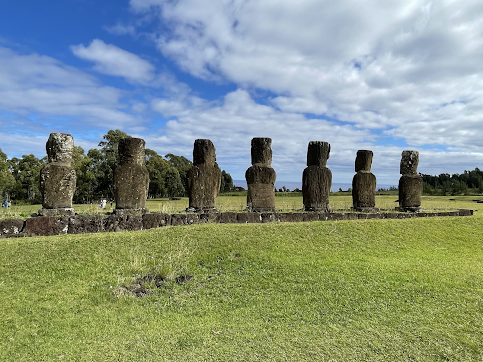
The first day of the tour, we visited Ahu a Kivi, which has 7 moai on an ahu (stone platform). Moai, in general, are thought to be the faces of deified ancestors of the Rapa Nui. These 7 moai are different than most because they face out to the ocean, while all of the other moai face inland, protecting their people. This brings up an interesting point in historical restoration. Sometime between 1722 and 1850, all of the moai had fallen down or been toppled over. We know they were still standing in 1722, because the Dutch explorer Jacob Roggeveen visited the island for a week, arriving on Easter Day (hence the name Easter Island), and his journals indicate the moai were standing then. He also says there were 2,000-3,000 people on the island at that time and that "all the country was under cultivation." This was the first known interaction between the Rapa Nui and Europeans, and, as you might guess, things did not go well after that for the Rapa Nui. During that specific interaction, "when the Dutch got to shore, the islanders pressed around them, tried to touch the Dutch, their clothes, and even their guns. During this, a shot rang out from an unknown person, leading to a firefight that killed ten or twelve islanders." How could it be a firefight when only one side had guns? Sounds more like a firing squad. Additional interactions with Europeans led to disease, slave raids by Peruvians, all kinds of problems that contributed to "societal collapse." By 1892, there were only 101 Rapa Nui alive on the island. Read the wiki page for the entire history, it's shocking.  https://en.wikipedia.org/wiki/History_of_Easter_Island

So, how and and why the moai were toppled is a large question. Some believe different Rapa Nui tribes toppled other tribes' moai in anger and violence after the Dutch arrived. But there are not forts or strongholds on the island that suggest the Rapa Nui were at war with each other. Others believe the Rapa Nui toppled the moai because "the island's ecosystem was severely impacted by deforestation, leading to resource scarcity and conflict among the Rapa Nui people. This environmental crisis likely contributed to a loss of faith in the effectiveness of the moai and their ability to protect the islanders." As will be a common theme on this trip, we left with more questions than answers. You can see the restoration efforts on the moai. For example, in the picture below, they reattached the head of the moai to the body with cement. But arguably these moai originally faced inwards to the island center just like the rest of the others did. But whoever restored these moai chose to face them towards the sea to better illustrate the story of the original voyagers who discovered the island: 2 navigators and 5 men sent by the king Hotu Matu'a from the island of Hiva in the the Marquesas Islands. Was the restoration team wrong to alter the position of moai for storytelling purposes? Debatable. Are the moai still impressive? Very.