Thursday, June 5, 2025

Rapa Nui: Tour Day 1: Puna Pau, Vinapu

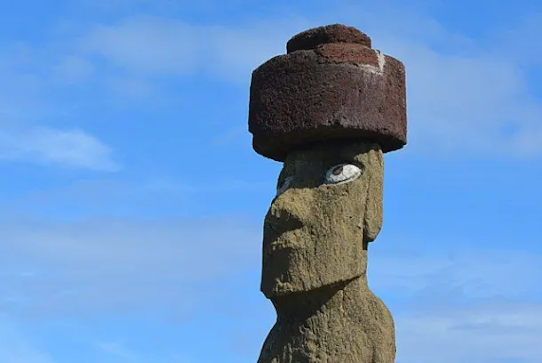
 After Ahu a Kivi, we went to Puna Pau, which is the quarry site for the red scoria (porous, volcanic rock) that the Rapa Nui used to make the crowns/hats/top knots that some of the moai have. The second picture shows an example of a moai with such a hat. The hats crack me up. The Rapa Nui spent years carving these gigantic moai, took all the trouble to move the moai to the desired location, and then said "you know what this thing needs? A hat! Let's make our jobs that much harder by attaching a separate object carved from a separate quarry on top of this 30 foot high statue." Funny. That sounds like a decision made by management, not by the worker. Goes to show some projects are done regardless of the extra pain and toil required. 


The hats were fixed to the moai with a peg and hole design, and you can see in this picture a hat with the hole carved out. You can also get a sense for how big the hats themselves were, taller than a person! The next question is how the Rapa Nui managed to raise the hats onto the moai. You'd think they'd try to raise both the hat and the moai at the same time. But, alot of the hats date later than the moai themselves,  meaning they were attached after the fact. How? With ropes? With a ramp? Another question to throw on the pile. They were understandably rolled from the quarry to the chosen ahu, but, after that, experts are unsure. There were numerous abandoned hats scattered around the outside of the quarry. What moai were they for? Why were they abandoned? Shoulder shrug. 


We visited Rapa Nui in the rainy season, which is also the off season for tourists. Made everything much less crowded, which was great, but we definitely had some rainy days toward the end of the trip where we couldn't do much. Luckily, we were there for so long we had additional flexibility to pick the best weather days for things. I could see if you were trying to cram in everything into a long weekend, and it rained the whole time, it would be pretty demoralizing. Some of the sites, the main moai quarry Rano Raraku in particular, they close when it rains as it becomes dangerous to hike around with the steep, slippery rocks. The day we visited these sites, the weather was great. Another added bonus to the rainy season were the incredible number of flowers in bloom, these yellow guys in particular. The island was absolutely covered in them. 


Next we visited Ahu Vinapu, which is an original intact ahu (many of the other ahus were rebuilt when the moai were reraised). The stone work on this ahu is beyond impressive. The rocks have been shaped perfectly square, and there is hardly any gap at all when the stones are joined together. Given the porous nature of this volcanic rock, achieving this level of perfection without metal tools would have required some serious stone working skills, skills that are unfortunately completely lost to the Rapa Nui today. Our tour guide, who if you'll remember is 100% Rapa Nui, actually does not believe his own people made the ahus and moai, but that, instead, another alien race inhabited the island before the Rapa Nui arrived, and they left during some cataclysmic event, leaving the ahu and moai behind for the Rapa Nui to discover. As far as conspiracy theories go, this one is pretty out there. But I found it shocking and somewhat depressing that an actual Rapa Nui had so little confidence in his own people that he couldn't believe they built all this stuff. It is true that today the Rapa Nui couldn't do it without modern tools. The ancestral knowledge has been indeed lost, and that is truly depressing. Brings forth questions about the impacts and beliefs surrounding colonization. So many colonizers believed they were "helping" the indigenous heathens, because our beliefs and customs must be the "right" way, when in reality they didn't need to be helped. The Rapa Nui clearly was a thriving, highly advanced society, and it wasn't until European explorers found them did things start going sideways. It always seems to be about taking by the colonizers. Taking resources, land, literal people. Never is it about learning, about sharing. Now, there are definitely times when things get so out of hand, help is needed. The Chileans would argue they stepped in and made Rapa Nui a territory because the situation was dire, and the people needed support. Today's missionaries in various places would probably so argue the same. We're digging wells and providing modern medicine to remote places. And that's true. But they're fixing problems that are the result of hundreds of years of abuse. The damage is done though, I suppose. Let's just do the next right thing and hopefully learn a few lessons from history. 


Fallen moai. They traditionally face-plant due to their large bellies. There are so many fallen moai all over the island. Why doesn't anyone pay to have them raised? Gotta be one philanthropic millionaire out there  who doesn't need a monetary reason to do it. 


Wednesday, June 4, 2025

Rapa Nui: Tour Day 1: Backstory and Ahu a Kivi

 The boys had a week and a half off from school for Fall Break, so we decided to use the extended break for a 9 day trip to Rapa Nui, also known as Easter Island. Rapa Nui is famous for the large, mysterious statues littered across the island. It's a place Drew and I have always been curious about, so we decided to check it out. It is similar to Hawaii in how far away it is from the coast. It was a 5.5 hour plane ride to get there. It is now also, unbeknownst to me prior to this adventure, a territory of Chile, and you can only get there by flying from Santiago. So lucky for us, we got to pay non-international prices for our plane tickets. When you look at Rapa Nui on google maps, it looks like it is literally in the middle of the South Pacific Ocean. 


When you zoom in a bit more, you see that Rapa Nui is sorta close-ish to other South Pacific islands. The closest land is Pitcairn Island, which is still 1,289 miles away.  Technically, it is in the farthest corner of the Polynesian triangle, with New Zealand and Hawaii anchoring the other vertices. That resonates with me, because Rapa Nui seemed to me to be the birth child of Hawaii and New Zealand. It had the tropicalness of Hawaii, but still had lots of open pastures and the wild, raw beauty of New Zealand. Rapa Nui is believed to be one of the last places on Earth to be inhabited by humans (except Antartica, of course). That alone made me want to visit it. Scientists debate when it was first inhabited, with the date ranging from 300 -1200 CE.  It's believed voyagers from the Marquesas Islands were the ones who settled Rapa Nui, which is 2,275 miles away. Māori (the indigenous people of New Zealand) sailing vessels can sail about 60 nautical miles in 24 hours given a moderate breeze. Needless to say, it would have taken those voyagers 38 days of sailing non-stop to reach Rapa Nui. That doesn't take into account bad weather, breaks, getting "lost," (which is a lark seeing as the voyagers didn't know where they were sailing to); it is amazing they made it at all!! That is some human stubbornness and determination right there.  It also seemed like one of those places that makes sense to visit only if you're in this part of the world, so off we went.


Most of the moai (statues) are located within the Rapa Nui National Park which you need to buy a 10-day pass in order to enter. Since we had our temporary residencies, we were able to get a local pass which was much cheaper. It is required that you visit the sites with a Rapa Nui guide. This is required for a couple reasons. One, they want to ensure the sites are respected and that there is no defacing or destruction to the moai. Second, it creates well paying jobs for the Rapa Nui people. If you are an indigenous Rapa Nui, you can be a guide automatically. If you aren't, you can take a certification course to learn all about the history and become a guide. We had booked a 2-day tour with the husband of our Airbnb host who was 100% Rapa Nui. Luckily the wife came along to translate, because, while the husband was speaking Spanish, it was very garbled and hard to understand. 


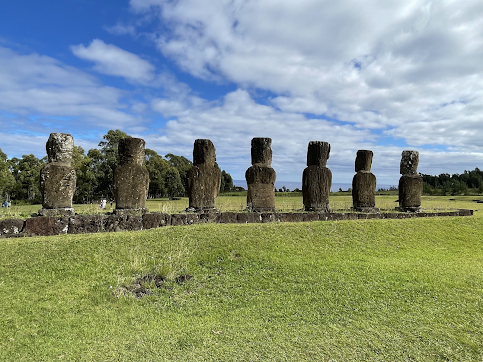
The first day of the tour, we visited Ahu a Kivi, which has 7 moai on an ahu (stone platform). Moai, in general, are thought to be the faces of deified ancestors of the Rapa Nui. These 7 moai are different than most because they face out to the ocean, while all of the other moai face inland, protecting their people. This brings up an interesting point in historical restoration. Sometime between 1722 and 1850, all of the moai had fallen down or been toppled over. We know they were still standing in 1722, because the Dutch explorer Jacob Roggeveen visited the island for a week, arriving on Easter Day (hence the name Easter Island), and his journals indicate the moai were standing then. He also says there were 2,000-3,000 people on the island at that time and that "all the country was under cultivation." This was the first known interaction between the Rapa Nui and Europeans, and, as you might guess, things did not go well after that for the Rapa Nui. During that specific interaction, "when the Dutch got to shore, the islanders pressed around them, tried to touch the Dutch, their clothes, and even their guns. During this, a shot rang out from an unknown person, leading to a firefight that killed ten or twelve islanders." How could it be a firefight when only one side had guns? Sounds more like a firing squad. Additional interactions with Europeans led to disease, slave raids by Peruvians, all kinds of problems that contributed to "societal collapse." By 1892, there were only 101 Rapa Nui alive on the island. Read the wiki page for the entire history, it's shocking.  https://en.wikipedia.org/wiki/History_of_Easter_Island

So, how and and why the moai were toppled is a large question. Some believe different Rapa Nui tribes toppled other tribes' moai in anger and violence after the Dutch arrived. But there are not forts or strongholds on the island that suggest the Rapa Nui were at war with each other. Others believe the Rapa Nui toppled the moai because "the island's ecosystem was severely impacted by deforestation, leading to resource scarcity and conflict among the Rapa Nui people. This environmental crisis likely contributed to a loss of faith in the effectiveness of the moai and their ability to protect the islanders." As will be a common theme on this trip, we left with more questions than answers. You can see the restoration efforts on the moai. For example, in the picture below, they reattached the head of the moai to the body with cement. But arguably these moai originally faced inwards to the island center just like the rest of the others did. But whoever restored these moai chose to face them towards the sea to better illustrate the story of the original voyagers who discovered the island: 2 navigators and 5 men sent by the king Hotu Matu'a from the island of Hiva in the the Marquesas Islands. Was the restoration team wrong to alter the position of moai for storytelling purposes? Debatable. Are the moai still impressive? Very.


Saturday, May 17, 2025

Emerson's 7th Birthday

 On May 9th, 2025, Emerson turned 7 years old. How is it possible that we have a 7 year old! Unbelievable. The morning of his birthday, we started off with a yummy chocolate chip pancake breakfast, which is family tradition.


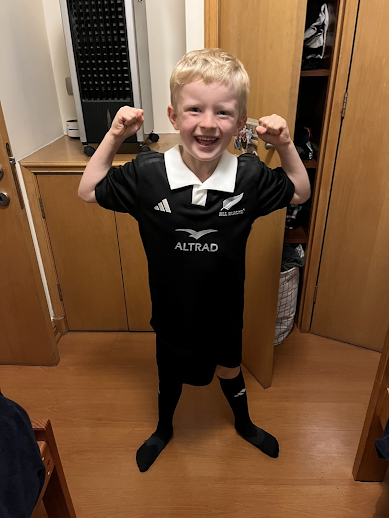
To celebrate at school, Emerson was allowed to wear "street clothes," aka not his uniform. So, after breakfast, he opened up a present from Auntie Courtney in Australia, which was an All Blacks Rugby jersey from New Zealand, where Courtney is from and where we've visited several times. The All Blacks are the best rugby team in the world. They are like the Yankees in baseball, except they come from a super small island with far less resources and budget, and yet they still dominate. Since the boys are learning rugby at their school, I thought it would be cool if they had All Blacks jerseys, so I asked Courtney for them awhile back. She graciously bought them on a trip home and shipped them to us. The shipping from Australia cost $56, probably close to the cost of the jerseys. Yikes. Thanks Auntie Courtney!!


In addition to street clothes, Emerson is also allowed to bring in a treat to share with his classmates. Traditionally, people bring in a cake made of barquillos, also known colloquially as cuchuflí. They are similar to praline sticks Nana used to bring out for Christmas, except they are normally lined in chocolate and then filled with dulce de leche, manejar, or Nutella. We got to try some from a local barquilleria down the street, and they were amazing, so I was very excited to order them for Emerson's class and possibly have a couple left over for us. I order the "cake" on Sunday, and his birthday was on Friday. So, I set the delivery for Thursday night, between 6-8pm. Well, Thursday we had a giant rain storm; it basically rained all day. So when there was no sign of the cake at 7:30pm, I called the shop and asked what was the deal, as I knew the shop closed at 8pm, and after that I wouldn't be able to talk to anyone. The lady told me, I think, that the delivery guy was leaving in 20 minutes, and everything was fine. Well, the cake never showed up. At 9:30pm, we went to bed hoping for a miracle midnight delivery, these are just guys who zoom around on scooters, and they operate at all hours. But, it was not meant to be. In the morning, no cuchuflís. I took the boys to school, then rode my bike straight over to Líder, our Walmart equivalent that is 5 min away where we do most of our shopping, and bought the saddest little muffins to take back and drop off at school. There was nothing else available: no cupcakes, no cookies, nothing. So he got sad little muffins. At this point I was pissed and sad. For one, I didn't understand what had went wrong; did I make a mistake in the ordering process? Turns out the rain just made it impossible for the store to find a delivery person. But true to Chilean form, they did not notify me of this, I was just ghosted. I also worried Emerson's classmates would make fun of him for his sad muffins. I haven't talked about this a ton, but parents here let their kids eat like garbage; it's definitely a major difference from the Colorado schooling scene. Kids are bringing candy in their lunches every day, cookies, chips, every kind of junk food you can imagine. So sad muffins were probably not going to register on most of the kids' radars as celebratory birthday treats, but simply everyday food. But, whatever, I tried. Emerson said the muffins were yummy, and he had fun giving the extras away to teachers and such, so he didn't seem scarred for life by it.  So hopefully there won't be a therapy session in his future labeled "My mom doesn't love me because she sent me to school with sad birthday muffins." Whew.


That evening we had Emerson's birthday dinner. We have a tradition where the birthday person gets to pick out the dinner menu from top to bottom. Emerson ordered spaghetti and meatballs, cucumbers, blueberries, and chocolate cake (a flourless dense torte I've made in the past) covered with strawberry cream cheese frosting. Drew spent several hours on Friday making homemade meatballs and red sauce, which turned out great, and I made the cake. Since I don't have electric beaters, I knew the torte was a losing proposition, as you have to beat cream into stiff peaks, and I wasn't doing that with a hand beater. I've never seen a hand beater before, but one showed up in one of our bulk purchases of used kitchen stuff. It works decently well for simple things, sauces and such, but beating cream to stiff peaks was beyond me. Overall, dinner was a success, and between that and presents, Emerson proclaimed it was the "Best Day Ever!!" which always feels good. 


Also, the rain the day before cleared out all the smog, so that Friday was the clearest day we've had. Allowed us to see the mountains and the new snow fall really well. Very lovely. This is the view from our guest bedroom for whomever comes to visit!


We also got to talk with lots of family members virtually: Grandma, Grandpa, GG, and Uncle Adam, then Nana and Papa, Auntie Leah and Uncle Osman, and finally Auntie Stephie and the cousins. Thanks all for making Emerson's day feel super special. 

The following week, we had a birthday party for some neighborhood kids. We decided to skip the entire class birthday party tradition, and kept it smallish. We invited 5 other families, so 11 kids and 12 adults in all. We had pizza and an ice cream sundae bar, and we rented out the communal party room in our building since the group had gotten too large for our apartment. The event room has an adjoining garden, which is great for the kids to be able to run around. We didn't rent anything extra, no trampolines, no jumpy castles, etc, we just brought down some of the boys toys from upstairs and borrowed a soccer goal from a neighbor.  Emerson's favorite part was when he and his friends were making "stew" in the garden, aka mixing water with garden bits and bobs. Score for the simple things in life. It's not what you do, it's who you're with.


Thursday, May 8, 2025

Drew's Hernia Surgery


Last Wednesday, April 30th, Drew had surgery for two hernias. One was around his belly button that he got while lifting incorrectly. The other was one that he might have had from birth, an inguinal hernia. Emerson had an inguinal hernia at birth as well, which was much larger and obvious, that was surgically fixed when he was 6 weeks old. And Drew's Dad has had hernia surgery too, so this clearly runs in the family. Since they were already in there, Drew decided to have both fixed at the same time. One of the hernias was able to be fixed laparoscopically, but the second was not, due to the location. So, in the end, Drew had four openings in his abdomen, all of them about a cm in size. 

We had the surgery performed at Clínica Alemana, which is undoubtably the best private hospital in Santiago. Drew was able to schedule the surgery very easily. The only real wait time we had was about 5 business days to get the surgery pre-approved by our insurance. Without insurance, the surgery cost $7K. With private international insurance, our deductible is $700. 

Drew was due to the hospital at 6am, so he was gone before the boys woke up. I took the boys to school, and then walked to the hospital. Drew's surgery was scheduled for 8am, so by the time I got there at 8:30am, he was already in surgery. I knew this would likely be the case, but I was wondering if they would be late and wanted to wait with Drew in his pre-op room if I could. I also wanted to figure out where everything was. This turned out to be pretty complicated, but that was mostly due to the communication barrier as well as a lack of prep between Drew and I. The hospital has three main buildings. First there is a tower with 18 or something floors that is for consultations, evaluations, and normal doctor visits in varying specialties. There is a hospital building where the ER is and where all major surgeries are performed. This was where Drew got his finger stitched up awhile back. Finally there is a OB/baby delivery building across the street. Drew told me he was meeting the surgeon on the 3rd floor of the tower, so I started there. Went to the 3rd floor, which was Urology and Gastroenterology. Didn't seem like the right place, and when I asked a check-in person in Spanish where I could find my husband who was in surgery, she gave me the blankest look ever. Luckily there was another doctor there who heard me and understood what I was saying, or trying to say, who told me, in Spanish, that all surgeries are performed in the hospital part of the building. Makes sense. 

So I needed to go back to the main floor and walk over to the other section. I did this, found the Info desk at that area, and asked them where my husband was so I could wait. They told me, in Spanish, that they couldn't see which room Drew was assigned to (because he was in surgery already, and they don't make room assignments until after, but I didn't know that) and to go to the 3rd floor waiting room, as there is a big TV screen there with updates on patients in surgery. I went there, and this where the lack of prep came in. The board was listed by surgeon name and patient id only, not by patient name. When Drew had his rhinoplasty at Denver Health, it was not this way; they listed the patient update board by patient name, which is what I was expecting. So, I assumed this one was the same way, and when I didn't see Drew's name on the board, I began to get worried. Really, I should have asked Drew who his surgeon was ahead of time, but I didn't think to do that. I asked a nurse for help in Spanish, who walked me back to the nurses' station to do a deep dive on their computers. Thank God for nurses, they are always the heroes. The nurses confirmed Drew was in surgery right now, and they told me to wait at a different waiting room on the 4th floor. 

I did this for an hour, still checking the board but unaware that it wasn't patient names I was looking at but surgeon names. After an hour, which was supposed to be the duration of the surgery, the board never got updated with Drew's name (of course not), I went back downstairs to ask the info people again if they could see anything. They again said no, but this time they felt bad for me and asked an interpreter to come over and help me.  It is amazing what stress can do to the body. Riding back up in the elevator with her, I began to cry, completely against my will. I didn't want to cry. I didn't feel that overwhelmed, but the stress of not knowing what was going on definitely took over. The interpreter was a saint as well. She took me up to the 4th floor waiting room again, went in herself to talk to the nurses again while I took deep breaths in the waiting room, came back out and lifted my gringa veil of ignorance that, indeed, his information had been on the board the whole time, here is his surgeon, and he was still in surgery, so still no room assignment. Great. I should have known this by now, living in another country, but you should never assume you understand how things work. It's different. Assume it will be different. 


Anyways, about 15 minutes after that, the doctor called me saying Drew was out of surgery, that all went well, and the he was going to be in recovery for about 1.5 hours, after which he would be moved to a post-op room, and I could see him. This was at 10:15am, which I could now see very clearly on the update board. Face palm. So I waited in the waiting room for two more hours. At 12:30, I could see on the board he was out of Recovery and moved, but, again, no idea where to. I went back downstairs to info, and they could see now he was in room 1206. They tried to explain to me where room 1206 was, but I didn't follow it very well. I understood it wasn't in this building, so I assumed it was in the tower on the 12th floor. Where else could it be? So that's where I went, and that was also wrong. The 12th floor was something else diagnostic something or other, and they couldn't see on their computers where Drew was, so they couldn't help me either. At this point, I called the surgeon, as he had actually called me on his direct line earlier which I thought was amazing. So he picked up and told me in English that Drew had been moved to the Maternity building across the street via an underground tunnel. Ack. That's what the info ladies had been trying to describe to me. So I went across the street, went to the 2nd floor (go figure), and found Drew in his room. This was around 1pm. Le sigh. 

Avery gets out of school at 1pm, and I had arranged for our neighbor who has a daughter in Pre-K to pick him up and bring him back to our apartment where our cleaner Karen was waiting to watch him. That all went fine. I stayed with Drew in his room for the next several hours waiting for the doc to come discharge him. Again, don't assume anything in another country. At Denver Health, they discharged him relatively quickly. Once he was out of recovery there, he was discharged within a couple of hours while he was still pretty dang loopy from pain meds. So this, again was what I was expecting here. When I got to Drew this time, he was completely sober already, but uncomfortable for sure. When they served him lunch at 1:30pm, I knew we weren't going anywhere soon. At 3pm I asked the nurses when we would be discharged, and they said we had to wait for the doc. At 3:45pm, I Whatsapped the doc (again, he gave us his direct number, and he would chat with patients on Whatsapp!) and he said he'd be by around 5pm to discharge Drew. So I left to go pick Emerson up from school at 4pm and to drop him off at home. Karen needed to leave, so she was replaced by our regular babysitter Catalina at 5pm. I then went back to Drew, luckily the hospital is literally down the street from our place, so it was easy to get back and forth. The doc came in with a pain med prescription and care instructions. I raced to the pharmacy and got the prescription filled in 15 minutes. Went back. He was finally discharged at 6:30pm. We took an Uber the 3 minutes home, and then everyone went to bed. Whew. 

His recovery plan seems relatively straight forward. No exercise at all for a week. Post-op check-up after a week, that will be today. Then light exercise for a couple of weeks. After a month he can lift light things, then slowly build up to lifting heavy things. Actually, the hardest part in the initial 48 hours was keeping the boys from accidentally bumping/jumping on his stomach. It basically meant the boys needed to stay away from Drew completely while he rested, so I've been solo parenting for awhile. By Day 3, Drew was able to get up more and start walking around. Now, Drew can stand up/sit up for longer periods, and he's even cooked some. But all kid duties and activities have been done by me for the past week, and as you can probably tell, I'm tired. I honestly have no idea how single parents do this day in and day out. It wouldn't be too bad for only a week, but the boys clearly miss their dad, miss playing with him and being silly with him and rough housing with him. I am not the fun parent, we know this. And those feelings come out as frustration. Frustration at having to do homework, frustration at having to clean up messes, frustration at having to tie my own shoes. Anything really. And when they get frustrated, they fight with each other, both physically and verbally, resulting in more tears. So that's been the exhausting part for me is trying to stay patient while the boys have constant melt-downs over seemingly any and everything. But deep breaths, this to shall pass. And wine. Lots of Chilean wine. And every day as Drew is able to do more and interact with them more, they are balancing back out. 

Friday, April 25, 2025

Easter and Kirchnerismo

 Last weekend we celebrated Easter here in Chile, which I thought was worth documenting because of how important it is down here. The boys actually had Good Friday off from school as well as a half day on Holy Thursday. We learned this the hard way, because those dates weren't listed on the school's "No School" calendar. I now realize that the list provided by the school doesn't include ANY public holiday,  only the additional ones taken off by the school. It's lucky I was paying attention to the Whatsapp classroom chats, or else we would have shown up on Friday with lunch boxes in hand. It's a bit of a bummer, because we could have used the long weekend to travel, but as it turned out, the boys and Drew had a nasty virus the week before, high temps, lethargic, and deep coughs for Emerson and Drew. So even if we had a trip planned, we would have been in rough shape. So instead, we stayed close to home and recuperated. 

On the Saturday before Easter, some friends of ours found a craft that was being put on by a local cultural center. It was free, so we decided to go. Turned out it was a huge event, with room for 200 kids.  We got there a half hour early, as the Insta post suggested, and ours were literally the last couple of kids that were admitted. Others got turned away. I found this hilarious because every other event we have been to in Santiago has been a "you're weird if you show up on time" sort of situation. But not this one! We were decorating Easter baskets. Boys had fun. 


Avery and I had our picture taken at the event, and when the photographer asked our name and I said "Kirchner" she thought we were related to the previous President of Argentina, Cristina Fernández de Kirchner (CFK). Being down here, this has come up a couple of times now, so I thought I would mention it.

CFK was the First Lady of Argentina when her husband, Nestor Kirchner, was President from 2003-2007. Then she was President immediately after from 2007-2015. And then she was VP from 2019-2023. Between her and her husband, they've branded their ideas as Kirchnerism or "Kirchnerismo" in Spanish. This is the Gemini response to "What is Kirchnerism."

Kirchnerism (Spanish: Kirchnerismo) is an Argentine political movement based on the ideology of Néstor Kirchner and Cristina Fernández de Kirchner, who consecutively served as presidents of Argentina. Here's a breakdown of its key characteristics:

  • Peronist Roots:
    • Kirchnerism is considered a branch of Peronism, a historically significant Argentine political movement. However, it distinguishes itself with its own specific interpretations and policies.   
  • Left-Wing Populism:
    • It's generally categorized as left-wing populism, emphasizing social justice, income redistribution, and a strong role for the state in the economy.
  • Key Policy Areas:
    • Social Programs: Kirchnerism is known for implementing and expanding social welfare programs aimed at reducing poverty and inequality.
    • Human Rights: A strong focus on human rights, particularly concerning the prosecution of those responsible for abuses during Argentina's "Dirty War."
    • Economic Nationalism: Policies that prioritize national economic interests, often involving state intervention and protectionism.
    • Latin American Integration: A tendency to favor close ties with other left-leaning governments in Latin America.
  • Relationship to Peronism:
    • While deriving from Peronism, Kirchnerism has at times clashed with other Peronist factions. It is seen as a reinterpretation of Peronism for the 21st century.
  • Economic Policies:
    • It has been characterized by state intervention in the economy, including nationalizations and price controls.

In essence, Kirchnerism represents a particular brand of Argentine politics that blends Peronist traditions with a contemporary left-wing populist approach. Source: https://en.wikipedia.org/wiki/Cristina_Fern%C3%A1ndez_de_Kirchner

The theory sounds good, right? But, I believe people have bad feelings about her, as there were alot of corruption scandals during her presidency. When I asked our Spanish tutor about her, he said she was a criminal and completely corrupt. Doesn't sound like actions are aligning with words. And a criminal in office, that could only happen in South America, right? Lol. But funny about the Kirchner connection, huh? The husband, Nestor Kirchner, was born in 1950 in Rio Gallegos, which is a town down in the Argentinian part of Patagonia, and his wiki page says he was a third generation Kirchner living there of German-Swiss descent.  Which would mean his grandfather would have immigrated in likely the late 1800's, early 1900's. Our Kirchner clan immigrated to Detroit in roughly 1925. So, as far as we know, we are not related to each other, but, somewhere farther back in time, it's certainly possible. 

For actual Easter, Chileans are all about the chocolate eggs and bunnies, so that felt very much the same. But I could not find plastic Easter eggs to set up an Easter egg hunt in the house. Not sure if they hide the chocolate eggs straight? But the plastic ones were no where to be found. It also felt strange to be celebrating Easter in the fall. Bunnies and rebirth and falling leaves? No blossoms Everyone in the Southern Hemisphere that celebrates Christian traditions has to acquiesce to Northern Hemisphere norms, and I never realized how weird it must be until now. Granted if that's all you've ever known, I suppose singing "Let It Snow" in the middle of summer still has that warm, fuzzy, nostalgic feeling if it's tied to fond family memories, but still. How do they not feel ripped off? My favorite Easter tradition is making deviled eggs, which was no problem whatsoever. Hooray!


Wednesday, April 16, 2025

Mendoza Trip: City Day 2

On our second day in Mendoza, Drew had booked us a walking tour, which, in my opinion, is a wonderful way to see any city. You get a much deeper historical perspective, and there is a lot to gain hearing a local's perspective as well.  The first piece of info shared was that in 1861, Mendoza suffered a 7.2 level earthquake, which killed more than 12,000 people, and the entire city was basically destroyed. So you aren't going to see super old, colonial aged buildings within the city for this reason. The city was rebuilt in a slightly different location over the next few years. They integrated a plaza structure into the city planning, basically parks that provide safe open space for people to flee to if there was ever another earthquake of that severity. You can see the large Plaza Independencia in the middle, with four satellite plazas radiating off of it, for this purpose.  The satellite plazas are: Plaza España, Plaza San Martin, Plaza Chile, and Plaza Italia. We visited Plaza España, Plaza San Martin, and Plaza Independencia on the tour, and then Drew and I hit the other two in our own explorations.


The next tidbit the tour guide shared was that in addition to the plaza integration, the city planners also wanted to provide the city with the feeling of an oasis. This part of Argentina is extremely dry, as the Andes block all of the moisture coming from the Pacific in the west. So all of the irrigation is brought in from rivers that come off the mountains, and it's controlled with canals, ditches, etc. So the entire city has these deep ditches in between the sidewalks and the roads, to control the flow of water. She said you're not a true Mendozian until you have a personal story of falling into one of these ditches, sober or otherwise.  They achieved the oasis feeling by planting an impressive amount of trees, every 15 feet or so along every street in downtown. The skyline is not particularly tall, you so get the lovely, tree-lined avenue feeling throughout the entire city. The trees also take advantage of the ditches for water. The trees also provide much needed shade, as apparently in the summer, temps can get up into the 90s. 


There were also trees I had never seen before. This was my favorite. It looked like a weeping willow, but it was huge, and the leaves were more fern like. No idea what it was specifically; any tree lovers out there that can shed some light? 


The first plaza we visited on the walking tour was Plaza España. The first thing you notice when you start walking through it is that the entire thing is covered by beautiful little colored tiles. They do repeat eventually, but there must be 24 or more different patterns. I think they're supposed to represent different provinces in Spain?


In the center of the Plaza is a lovely fountain that leads you to a large statue and tiled mural. The statue depicts the relationship between Spain and Argentina during the 1600s and 1700s. Spain is the lady on the viewer's left. She is larger and more mature, and she holds books, representing the culture, history, and learning Spain provided to Argentina. Argentina, the lady on the right, is smaller and physically more immature, and she holds grapes, representing the agricultural fruits of labor Argentina provided.  You can also see the ox and plow on the bottom section of the statue, mirroring this same sentiment, while above that is a ship, showing the immigration from Spain.


The tiled murals were impressive. The one in the middle depicts the meeting of the indigenous peoples with the Spanish immigrants, having peaceful, Thanksgiving vibes at the founding of the city by Pedro del Castillo in 1561. Guessing it didn't go down that way, but that's what it shows. 


The mural on the far right is a scene from Don Quixote. The scene to the left of that is more farming love. It's clear what Argentina was valued for back then. The dry climate with mountain water irrigation makes it the Napa Valley of Argentina. 


The mural on the far left is a scene from another famous literary work, this time a poem called The Gaucho Martin Fierro written by José Hernández in 1872. To the right of that, the mural depicts the discovery of the Americas by Christopher Columbus. In the moment, this surprised me; why did they care about Christopher Columbus? But this was quickly followed by a "No Shit" second moment. Christopher Columbus discovered the Americassssss as in plural. North and South America. In 1492 when Columbus sailed the ocean blue, he actually landed in the Bahamas. And, to be fair, more of South America was claimed by Spain who funded Christopher Columbus than in North America. So they have an even stronger connection to him than us North American folks. And yet, my US default mentality was "That's our history, not yours!" Wrong. 


After Plaza España, we went to Plaze Independencia, which is the largest one in the middle. We had actually visited this plaza the night before, that was where the boys gathered their fan club. But this time around, we got more insight on the large fountain in the middle. Originally, this plaza was going to house the Parliment Building, and they even began construction on it. But then they changed their minds, and moved all government buildings to a different Civic Park a few blocks away. They then converted the foundation of that palace into the modern art museum we breezed through the night prior and a theatre. The fountain was added to decorate the outside later on. Pretty cool huh? Once you realize that info nugget, you can picture the ghost of that palace, can't you? Pretty cool. 


Along the tour we passed by the gorgeous old Banco Hipotecario National or National Mortgage Bank, which now the center of Culture in Mendoza. The building is younger than it looks, built in 1924, but I loved all the intricacies of its neoclassical architecture. 


We ended the tour in this very non-descript building that inside has this gorgeous stained glass ceiling. I honestly don't remember what this building was, now it's just a little shopping mall. But this is why I love walking tours with a local. We would have never seen this otherwise. 


After the tour, we went for lunch/dinner at a restaurant recommended by the tour guide called Fuente y Fonda, which serves traditional Argentinian dishes family style. It was delicious and right up our alley. We ended the day by going to the arcade that was directly below our Airbnb. The boys had been eyeing it all weekend, and now, when you ask them what their favorite part of Mendoza was, they say the arcade. 


Overall I loved Mendoza. It felt like Old Town Fort Collins but bigger. The food was definitely more expensive than what we were used to in Santiago, but it was delicious, as was the wine. It has very nice, tranquil vibes. I would definitely go back for a long weekend. Until then.